
Grace in the Dust
Pastor Daniel Courade
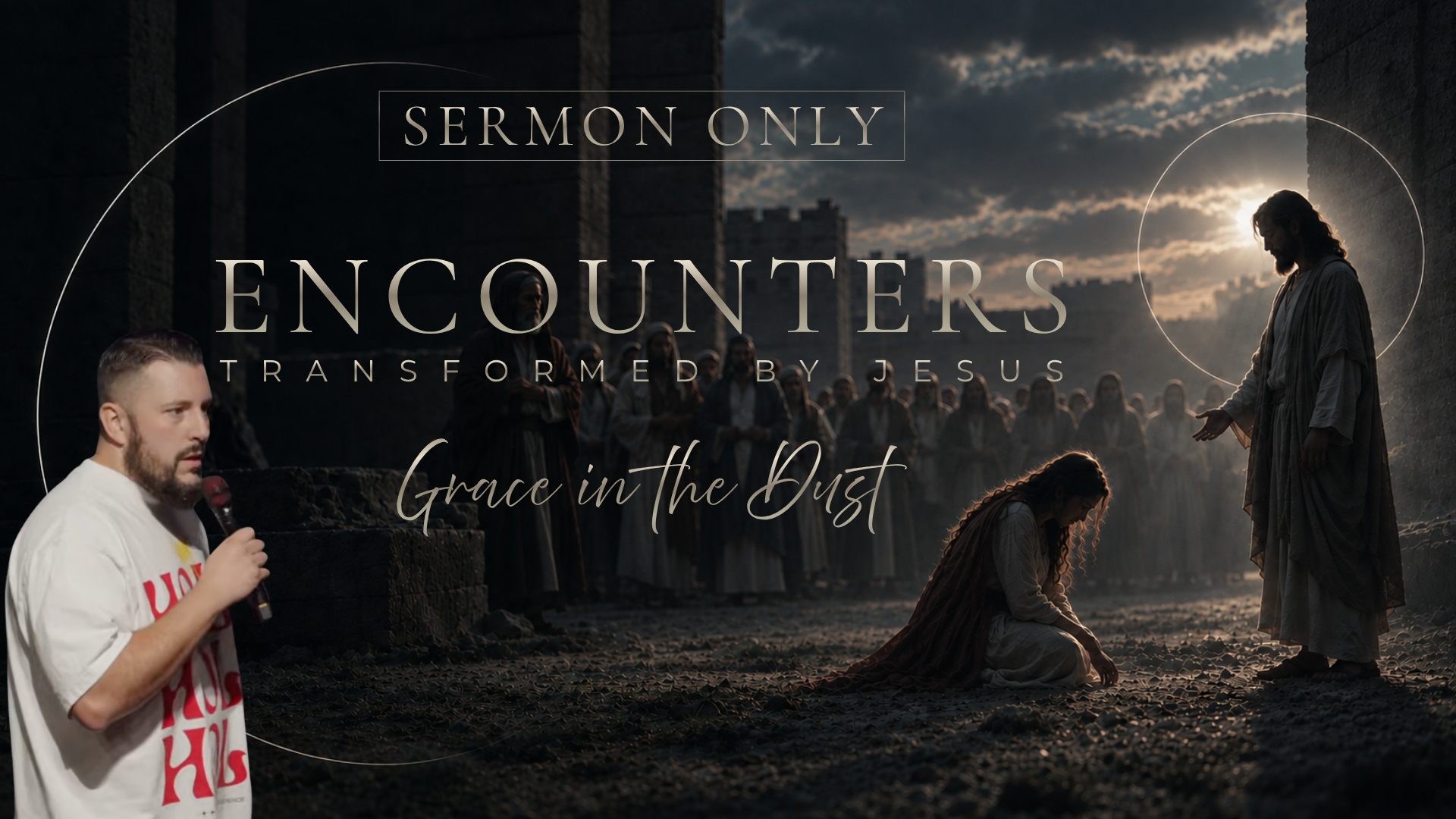
Grace in the Dust: When Jesus Meets You at Your Lowest
Have you ever made a mistake so big it felt like it was crushing your chest? I'm talking about the kind of mess-up that plays over and over in your head — the kind you can't escape. You're trapped in a repetition of shame and condemnation where your shame feels louder than the voice of God. And what's crazy is, sometimes it's not even other people holding the rocks in your head. It's you. You can't get the rock out of your own hand because you knew better. You shouldn't have — but yet you did.
Before long, you're living like your failure is your identity.
But I've come to tell you: grace meets you in the dust, and it doesn't leave you there.
The Woman, the Crowd, and the Dust
In John 8:1-11, we find one of the most powerful encounters with Jesus ever recorded. Jesus was teaching at the temple when the Pharisees — the religious leaders of the day — dragged a woman before the crowd. She had been caught in the act of adultery. They put her in front of everyone and demanded Jesus weigh in: "The law of Moses says to stone her. What do you say?" They were trying to trap him. The crowd stood ready, rocks in hand.
But Jesus didn't react the way anyone expected.
He stooped down and wrote in the dust with his finger. When they kept demanding an answer, he stood up and said, "Alright, but let the one who has never sinned throw the first stone" (John 8:7). Then he stooped back down and kept writing.
One by one, beginning with the oldest, the accusers slipped away — until only Jesus was left standing with the woman.
"Where are your accusers? Didn't even one of them condemn you?" he asked her.
"No, Lord," she said.
"Neither do I," Jesus replied. "Go and sin no more" (John 8:10-11).
This is what our sermon series, Encounters Transformed by Jesus, is all about. And today, I want to talk about redemption — what it means to be bought back, to have what was lost or ruined restored. There is nothing, and no one, too ruined for the grace of God.
Point 1: Drop the Rock and Pick Up a Mirror
We live in a world that is quick to expose others. We live in a culture that cancels faster than it forgives. We label people by their worst mistakes while hiding our own sin and spotlighting others.
The Pharisees came to that temple courtyard focused entirely on her. But Jesus forced them — and us — to see themselves. When he said, "Let the one who has never sinned throw the first stone," the spotlight moved from the woman to the crowd.
Here's the truth: we're all walking around carrying stones. Maybe not physically. But we have stones in our hearts, stones in our eyes. We walk around judging others as though we are God. As though we're worthy to hold the power of life and death in our hands.
Jesus is saying: that's my spot.
Drop the rock. You need grace, too.
It feels better to critique than to confess. It feels safer to expose others than to repent for the things we need to repent of. But when we stop looking down on others because they sin differently than us, we become reminded of all the ways we fall short too. As theologian Jonathan Edwards said, "You contribute nothing to your salvation except the sin that made it necessary."
The ground at the cross is completely level. There's not one person better than another who doesn't need the cross. Romans 3:24 says, "Yet God in His grace freely makes us right in His sight. He did this through Christ Jesus, when He freed us from the penalty for our sins."
The moment you drop the rock is the moment you make room for mercy.
Point 2: Jesus Meets You at Your Lowest So He Can Raise You to Your Highest
Notice what Jesus did while the crowd stood tall with rocks ready to pummel this woman. He got low. He stooped down and met her right where she was — in the dust.
Last time I checked, holiness doesn't look like standing tall over others with condemnation because you're good at following rules. The holiness of Jesus looks like getting down low in compassion and grace and meeting people right where they're at.
He's not a performance-based God. He's not surprised by your shortcomings. He knew you. He knew what you were doing when you did it. He sees all. And yet he has compassion for you — because he loves you and he wants to see you restored.
As Anne Lamott said, "I do not understand the mystery of grace, only that it meets us where we are and does not leave us where it found us."
That's exactly where he met me — a strung-out drug addict, addicted to alcohol, addicted to every drug under the sun, living for the day and not for my future. The grace of Jesus found me and picked me up out of the gutter.
So why do we struggle to believe he wants to meet us in our mess? Because shame is loud.
Shame says, you can't show your face. You've gone too far. You don't deserve forgiveness. But grace says, come closer. You are still loved. Turn to me — you're invited in.
Shame isolates. But grace restores.
What if your lowest place is actually your meeting place of restoration? What if the very thing you're trying to hide from God in shame is the very thing God is trying to touch? Don't put on a mask. Bring it to him. Let him meet you in your mess — not cleaned up, not once you've finally got your act together, but in the moment you realize you need him.
When you mess up, don't run from God. Run to him.
Point 3: Grace Is Not Permission to Stay in Sin — It's the Power to Come Out of It
Here's where it gets real. Jesus ended this encounter with two powerful statements in one breath: "Neither do I condemn you" — that's grace. "Go and sin no more" — that's truth (John 8:11).
We cannot separate the two. If you do, you're no longer preaching the full gospel.
Sometimes in the modern church, we've overemphasized grace — "I don't condemn you" — while under-emphasizing truth — "go and sin no more." But that wouldn't be a loving God. If I told my kids to go live however they wanted without caring about the consequences they'd suffer, that wouldn't be love. That would be neglect.
Jesus is not divided. He's not 50% grace and 50% truth. He's 100% grace and 100% truth, all at the same time.
And here's the good news: when I encountered the Holy Spirit, he gave me power — not to be perfect, but to live a life that honors God. His grace covers a multitude of sins, and he gives you the power to live a life that is free from sin, not by your own works, but by his grace.
As 2 Corinthians 5:17 says, "This means that anyone who belongs to Christ has become a new person. The old is gone and a new life has begun."
When you encounter Jesus, you're not just forgiven — you are transformed from the inside out.
So why do so many people stay stuck? Because we try to adjust behavior without surrendering the heart. Behavior modification without heart transformation will always pull you back into sin.
Romans 12:1-2 says, "Do not be conformed to the patterns of this world, but be transformed by the renewing of your mind. Then you will be able to test and approve what God's good, perfect, and pleasing will is for your life."
Putting It Into Practice
So what does this look like in real life? Here are some next steps flowing directly from this message:
Drop the rock. The next time you feel judgment rising toward someone else's sin, let it be a gut check. Pick up a mirror instead and ask, Lord, where am I not walking close to you?
Run to God, not away from him. When you mess up, don't hide. Don't stay out of prayer and out of the Word because you feel unworthy. His grace is loudest in your lowest moments.
Be honest, not impressive. When you pray, be real. You will never experience healing in the places you keep hiding.
Sever the ties. Remove the environments that pull you back down. Stop flirting with what Jesus died to free you from. Get around people who will tell you the truth, not just what you want to hear.
Replace old habits with new ones. Pick up godly rhythms and patterns. Empty space always gets filled with something — make sure it's filled with what leads you toward God.
Receive your new identity. Romans 8:1 says, "There is now no condemnation for those who are in Christ Jesus." You are not your worst mistake. Your failure is not your identity. Your past doesn't get the final word — Jesus does.
The place of your lowest moment becomes the place of his greatest mercy. Grace meets you in the dust, but it doesn't leave you there. He loves you too much to leave you there.
And we are all just one act of repentance away from being redeemed by grace.
Today is your day.